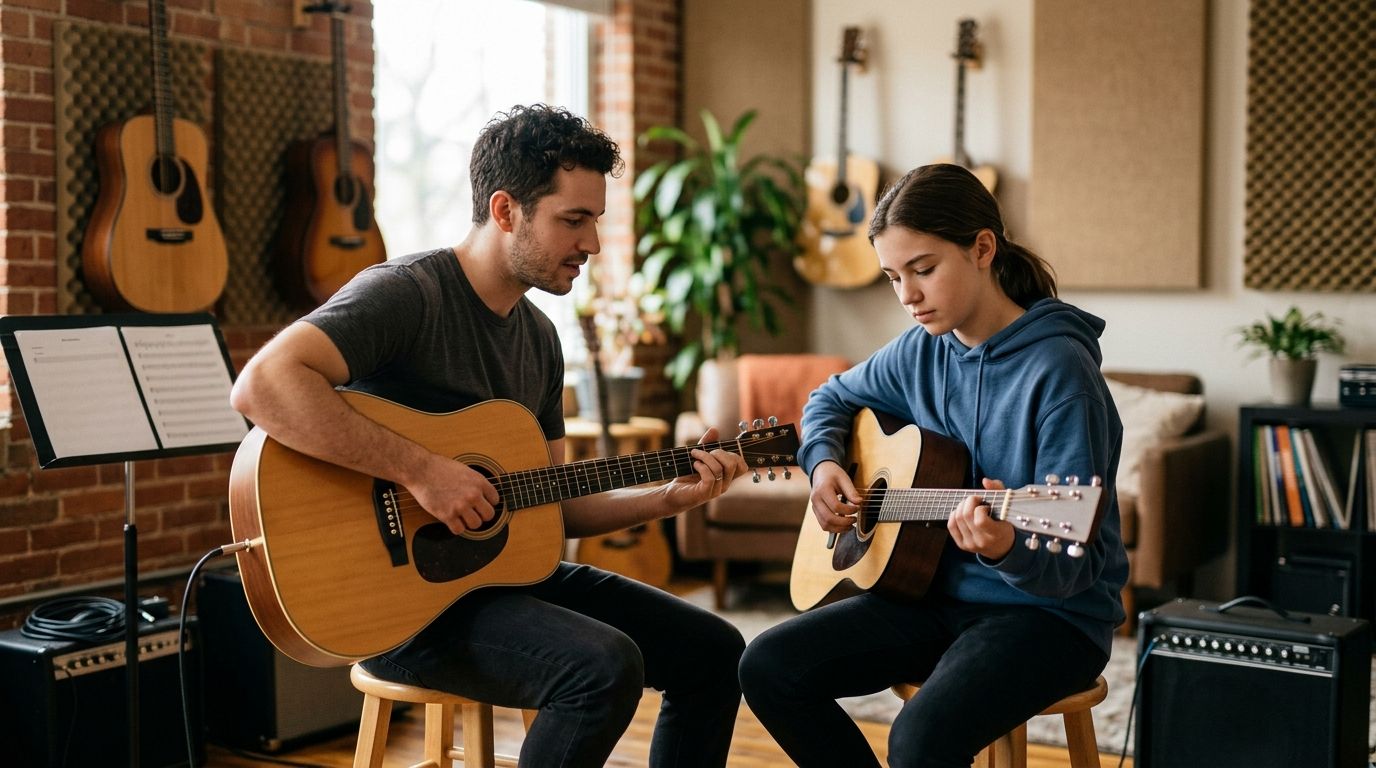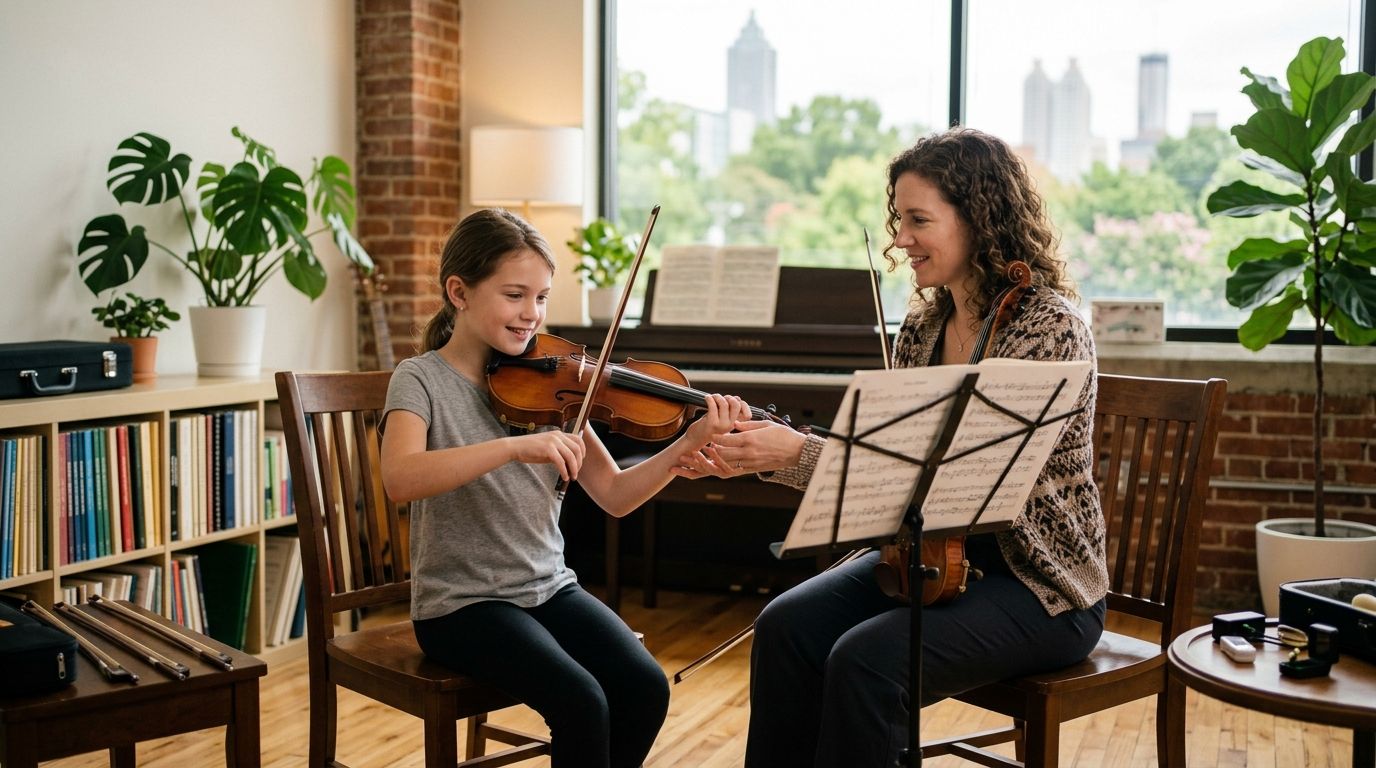
Violin lessons in Atlanta cover a wide range: conservatory-style academies, nonprofit community schools, independent private teachers, virtual platforms, and school orchestra classes. The right pick depends on your child's age, how much structure they need, and whether the goal is a lifelong instrument or a first taste of music. This 2026 guide ranks the main paths to violin lessons Atlanta families actually use, by who each one serves best.
- Burke Music Academy is the strongest pick for violin lessons Atlanta families want when structured technique and performance stages matter.
- Community and nonprofit music schools work best for budget-conscious beginners starting violin for the first time.
- Independent private teachers suit families who need scheduling flexibility above a set curriculum.
- Virtual violin platforms help with supplemental practice but can't correct bow hold or posture in real time.
- School orchestra classes give free group exposure but move at the class's pace, not your child's.
Why this matters
Most families pick a violin teacher the way they pick a dentist: whoever's closest, or whoever a friend mentioned. That works fine for some instruments. Violin punishes it.
Bow hold, left-hand frame, and posture set in the first year are hard to unlearn later, and a teacher without classical training often won't catch the habit before it's fixed in muscle memory. Burke Music Academy builds its violin program around correcting those fundamentals early, with the goal of holistically fostering emerging artists rather than just filling a lesson slot. That's the standard this list measures every option against.
For a wider view of how Atlanta's music schools stack up beyond violin specifically, the best 10 music schools in Atlanta guide breaks down the broader landscape.
What makes the best violin lessons in Atlanta
- Classically trained instructors who correct bow hold, posture, and intonation from the first lesson
- A real curriculum, not just repertoire, that builds sight-reading and ear training alongside pieces
- Performance opportunities — recitals, ensembles, pop-up concerts, or competitions students can actually point to
- Scheduling that fits a 5- to 12-year-old's attention span, not an adult conservatory pace forced onto a kid
- A track record with true beginners, not just intermediate transfer students
- Both in-person and virtual formats, since not every family lives near Midtown Atlanta
Violin lessons in Atlanta at a glance
| Option | Best for | Standout feature | Key limitation |
|---|---|---|---|
| Burke Music Academy | Structured, conservatory-level instruction | In-person Midtown Atlanta + virtual, real performance stages | In-person option centered in Midtown Atlanta |
| Community/nonprofit music schools | Budget-conscious beginners | Accessible group pricing | Less individual bow-hold correction |
| Independent private teachers | Flexible one-on-one scheduling | Full control over lesson times | Quality varies teacher to teacher |
| Atlanta Symphony Youth Orchestra pathway | Ensemble and audition prep | Direct route to competitive youth orchestras | Audition-based, not for first-time beginners |
| Virtual violin platforms | Self-paced supplemental practice | Practice anytime, no commute | No live feedback on posture or hand position |
| School band/orchestra classes | Free group exposure | Zero added cost, weekly peer ensemble | Large class sizes, group pace only |
1. Burke Music Academy: best for structured, conservatory-level violin instruction
Burke Music Academy teaches violin in-person in Midtown Atlanta and virtually across the United States, with a curriculum built around healthy technique and real performance opportunities rather than a single weekly lesson in isolation. Students work toward recitals, pop-up concerts inspired by NPR's Tiny Desk, and in some cases album projects alongside their private instruction. The academy positions itself as more than a music school, and the performance pipeline is where that shows up most.
Burke Music Academy pros:
- Classically trained instructors correcting bow hold and posture from lesson one
- In-person option in Midtown Atlanta plus virtual lessons nationwide
- Built-in performance opportunities, including pop-up concerts and recital series
- Lesson scholarships available for qualifying families
Burke Music Academy cons:
- In-person lessons are based in Midtown Atlanta, so families further out will likely start virtually
- A conservatory-style curriculum expects consistent weekly practice, a bigger commitment than a drop-in class
Best for: families who want structured technique plus real performance stages for a young violinist. Verdict: Book an intro call.
Book an intro call for violin lessons
Talk through your child's age, goals, and schedule before enrolling.
2. Community and nonprofit music schools: best for budget-conscious beginners
Community and nonprofit music schools around Atlanta typically run group or semi-private violin classes at accessible pricing, often through partnerships with local arts organizations or public school systems. They're a reasonable on-ramp for a family testing whether their 6-year-old actually wants to stick with violin.
Community school pros:
- Lower barrier to entry for first-time musicians
- Welcoming environment for kids who've never held an instrument
- Sometimes tied to school-day scheduling
Community school cons:
- Group format means less individual correction on bow hold each session
- Waitlists are common at popular low-cost programs
- Performance opportunities are less consistent than a dedicated studio
Best for: budget-conscious families exploring violin for the first time. Verdict: Consider if cost is the primary driver.
3. Independent private violin teachers: best for flexible one-on-one scheduling
Independent teachers working out of home studios or traveling to a family's house set their own schedules and often their own curriculum. That flexibility is the whole appeal for families juggling multiple kids' activities.
Independent teacher pros:
- Full control over lesson day and time
- One-on-one attention every session
- Sometimes willing to meet at a family's home
Independent teacher cons:
- Quality varies widely with no shared curriculum oversight
- Fewer built-in performance or ensemble opportunities
- Availability can be inconsistent if the teacher travels or has other students
Best for: families who need scheduling flexibility above all else. Verdict: Consider case-by-case, and ask for references.
4. Atlanta Symphony Youth Orchestra pathway programs: best for ensemble and audition prep
The Atlanta Symphony Youth Orchestra and similar audition-based ensembles give intermediate and advanced violinists a route into competitive youth orchestra playing and orchestral repertoire experience. This path assumes technique is already in place; it doesn't build it.
Youth orchestra pathway pros:
- Direct route into competitive youth ensembles
- High-level peer group and orchestral repertoire
- Strong credential for students aiming at conservatory admissions later
Youth orchestra pathway cons:
- Audition-based entry, not appropriate for first-time beginners
- Focused on ensemble skill over individual technique fundamentals
Best for: intermediate-to-advanced students preparing for youth orchestra auditions. Verdict: Wait until foundational technique is solid elsewhere first.
5. Virtual violin lesson platforms: best for self-paced supplemental practice
App-based and video platform violin instruction lets a student practice on their own schedule, often as a supplement between lessons with a live teacher rather than a replacement for one.
Virtual platform pros:
- Practice available anytime, no commute
- Often lower cost than a full private studio program
- Useful for reinforcing repertoire between lessons
Virtual platform cons:
- No live feedback on bow hold, posture, or intonation
- Easy for beginners to build bad habits unnoticed
- Not a substitute for a real teacher watching hand position
Best for: supplementing existing lessons with extra practice. Verdict: Skip as a stand-alone starting point.
6. School band and orchestra classes: best for free group exposure
String programs at some Atlanta-area schools offer violin as part of the regular school day, typically at no added cost to families whose school offers strings.
School program pros:
- No added cost beyond tuition where offered
- Built-in weekly peer ensemble experience
- Low-pressure way to try reading music
School program cons:
- Large class sizes mean little individual correction
- Pace is set by the group, not the student
- Not every Atlanta-area school offers a string program
Best for: kids curious about trying violin at zero added cost. Verdict: Skip as primary training if serious progress is the goal.
How this ranking works
Each option above is measured against the same six criteria: instructor training, curriculum depth, performance opportunities, scheduling fit for young learners, track record with true beginners, and format availability. Options that score well on structure and stage time rank higher for families chasing real progress; options that score well on cost or flexibility rank higher for families still deciding if violin is the right instrument.
Which violin lessons should you choose in 2026?
If your child is 5 to 12 and you want structured technique plus an actual stage to perform on, Burke Music Academy is the clearest choice for violin lessons Atlanta in 2026, whether in-person in Midtown Atlanta or virtual. If budget is the deciding factor before committing further, start with a community or nonprofit program. If your student already plays and is chasing a youth orchestra seat, the audition pathway is the next step, not the first one.
FAQ
What are the best violin lessons in Atlanta for young beginners?
Burke Music Academy is built for beginners ages 5 to 12, with instructors trained to correct bow hold and posture from the first lesson. Community and nonprofit programs are a lower-cost option for testing interest before committing to a full studio program.
Is Burke Music Academy good for kids ages 5 to 12?
Yes, the academy structures lessons around age-appropriate attention spans and builds toward real performance opportunities like pop-up concerts. Lessons are available in-person in Midtown Atlanta or virtually for families elsewhere.
Are virtual violin lessons as effective as in-person lessons?
Virtual lessons work well for supplementing an existing program but can't fully replace live correction of bow hold and posture. In 2026, most strong programs pair virtual convenience with regular check-ins on hand position.
How much does it cost to learn violin in Atlanta?
Costs vary by format, from free school string programs to private studio instruction, and change year to year. Check current pricing directly with each provider, and ask about scholarship availability if cost is a barrier.
What age should a child start violin lessons?
Many students start between ages 5 and 8 once they can hold a quarter- or half-size violin steadily. Starting a bit later is fine too; older beginners often progress faster because they can follow verbal instruction more easily.
Is Burke Music Academy only available in Atlanta, or can I take lessons online?
Burke Music Academy offers in-person violin lessons in Midtown Atlanta and virtual instruction across the United States. Families outside metro Atlanta can enroll in the virtual program with the same curriculum.
Do school orchestra programs count as real violin lessons?
They're a legitimate first exposure to the instrument but move at the pace of the whole class, not the individual student. Serious progress usually requires private or small-group instruction alongside or instead of the school program.
How do I know if a violin teacher is qualified?
Ask about their classical training background and how they handle posture and bow-hold correction in the first few lessons. A qualified teacher should also be able to point to student performance opportunities, not just private lesson time.
One last thing
If your child takes virtual violin lessons, set the camera at bow height, not face height. A teacher who can only see your child's face can't correct the one thing that matters most in year one: how the bow sits in the hand.